
Documents Found with St. Clair County Deed Records
Deeds in St. Clair County are recorded with the Judge of Probate rather than a separate recorder's office. Each deed names the parties, describes the land, and states the interest conveyed. But the deed rarely stands alone. Easements, corrections, releases, mortgages, plats, rights-of-way, and restrictions can all attach to the same tract. These can change what that deed really means.
| Deed Type | What It Does | Common Use |
|---|---|---|
| Warranty deed | Conveys the stated estate with covenants | Ordinary purchase and sale |
| Quitclaim deed | Conveys only the interest the grantor may hold | Interest cleanup or family transfer |
| Correction deed | Corrects an earlier recorded instrument | Name or description correction |
| Executor or estate deed | Conveys land through estate authority | Probate-related transfer |
| Foreclosure or tax-related deed | Records a transfer from a special process | Foreclosure or delinquent-tax history |
A mortgage or lien works differently than a deed. It burdens the land without transferring ownership. Before trusting a single entry, look for later assignments, satisfactions, releases, and amendments tied to that same instrument.
St. Clair County Deeds Go Through Probate
Real-estate instruments are recorded with the official St. Clair County Probate Office. The county operates two full-service offices. One sits in Suite 101 at 165 5th Avenue in Ashville; the other in Suite 212 at 1815 Cogswell Avenue in Pell City. Both are open weekdays from 8:00 a.m. to 4:30 p.m., reachable at 205-594-2120 and 205-338-9449.
St. Clair County publishes no public grantor-grantee index or deed-image viewer on the web. Call the office and ask how records are searched by party, date, instrument type, book and page, or recording number, and whether copies can be mailed.
Identifiers for St. Clair County Deed Records
Mailing addresses change; legal descriptions stay with the land. Start with the Revenue Commissioner's parcel result and copy the PPIN and Parcel ID exactly. Preserve the owner-of-record style as written. Then give Probate every description clue you have, plus an approximate transfer date.
| Search clue | Why it matters | Where to confirm it |
|---|---|---|
| Grantor and grantee | Connects one conveyance to the next | Recorded instrument or index |
| Legal description | Identifies land despite address changes | Deed and recorded plat |
| PPIN or Parcel ID | Joins modern assessment and map records | Revenue search and GIS |
| Book/page or instrument number | Points to a specific filing | Probate recording reference |
| Subdivision, block, and lot | Links a parcel to its plat structure | Plat and deed description |
When parcels split or combine, trace the parent and child descriptions rather than expecting a modern PPIN in older deeds. Treat GIS last-deed and previous-owner fields as leads. They are not substitutes for the recorded instruments themselves.
Follow St. Clair County Deeds Through the Grantor-Grantee Chain
A chain of title tracks one described parcel across every recorded transfer in order. With no online county index available, gather the details that support a Probate Office search, whether by phone or in person.
- Use the Revenue record as a lead, then obtain the latest deed in which the current owner appears as grantee.
- Read the full legal description and copy the grantor's exact name plus the recording reference.
- Search that grantor as an earlier grantee, checking descriptions rather than relying on a name alone.
- Repeat the link, following corrections, plats, estates, splits, and merges when the land description changes.
- Grantor
- The party conveying the stated interest.
- Grantee
- The party receiving the stated interest.
- Chain of title
- The linked sequence of recorded conveyances for the same land.
- Book/page or instrument number
- A retrieval reference whose form can vary with the record era.
Historic St. Clair County Deed Records Beyond Modern Parcels
Older St. Clair County deed records predate the modern PPIN system. The WorldCat catalog lists filmed Ashville and St. Clair probate records covering 1850 through 1952. FamilySearch describes land records for 1823 through 1918 and an index spanning 1819 through 1903. These are starting points, not proof that your parcel appears in any given volume.
Bridge old and new records through party names. Metes-and-bounds calls, lot numbers, roads, rail lines, streams, and neighboring owners also help. Images may require an account, an affiliate library, or a visit. Historic maps help explain vanished place names. But only recorded deed books carry the legal chain of title.
Ashville Archives Add Context to St. Clair County Deeds
The Alabama Department of Archives and History gateway opens catalogs, county records, microfilm, newspapers, and maps. It also offers a research-request service. Its St. Clair finding aid covers Ashville, courthouses, post offices, industry, old homes, and county history. These sources can surface alternate names and time periods for a stubborn tract.
St. Clair County was formed in 1818. Later railroad and courthouse growth around Pell City can explain landmarks. Some no current street label matches. Use that context to frame the hunt, then confirm the land against recorded instruments.
Write a Precise St. Clair County Deed Records Request
A precise request names the record type. It should also list the parties, a date span, and every land identifier you hold. Ask for deeds, corrections, easements, and releases. Request mortgages, plats, and recording references too. All of these should be tied to the stated legal description or parcel number.
The county's general records policy sets 25 cents for letter- or legal-size copies. It also charges $25 per staff hour after the first hour and any supply costs. That figure may not match Probate's copy or certification fee. Ask for an estimate, and say whether you need a plain or certified copy.
Fields to Capture from Every St. Clair County Deed
Capture the instrument type, recording date, reference, exact party styles, legal description, consideration language if shown, any parcel reference, and all reservations or exceptions. Keep the execution date apart from the recording date. Then check for later corrections or releases.
- Compare the description with the prior link.
- Check later correction deeds and amended plats.
- Preserve name variants and entity punctuation.
- Do not republish signatures or needless identifiers.
Note: This inventory exposes gaps quickly and separates a true chain break from a mere indexing variation.
State Land Files Are a Separate St. Clair Search Path
The Alabama Secretary of State land-record page describes state land records from statehood through 1950 and points to county probate judges for later material. It supports early land research. But it cannot replace the St. Clair deed chain for recorded transfers after that handoff.
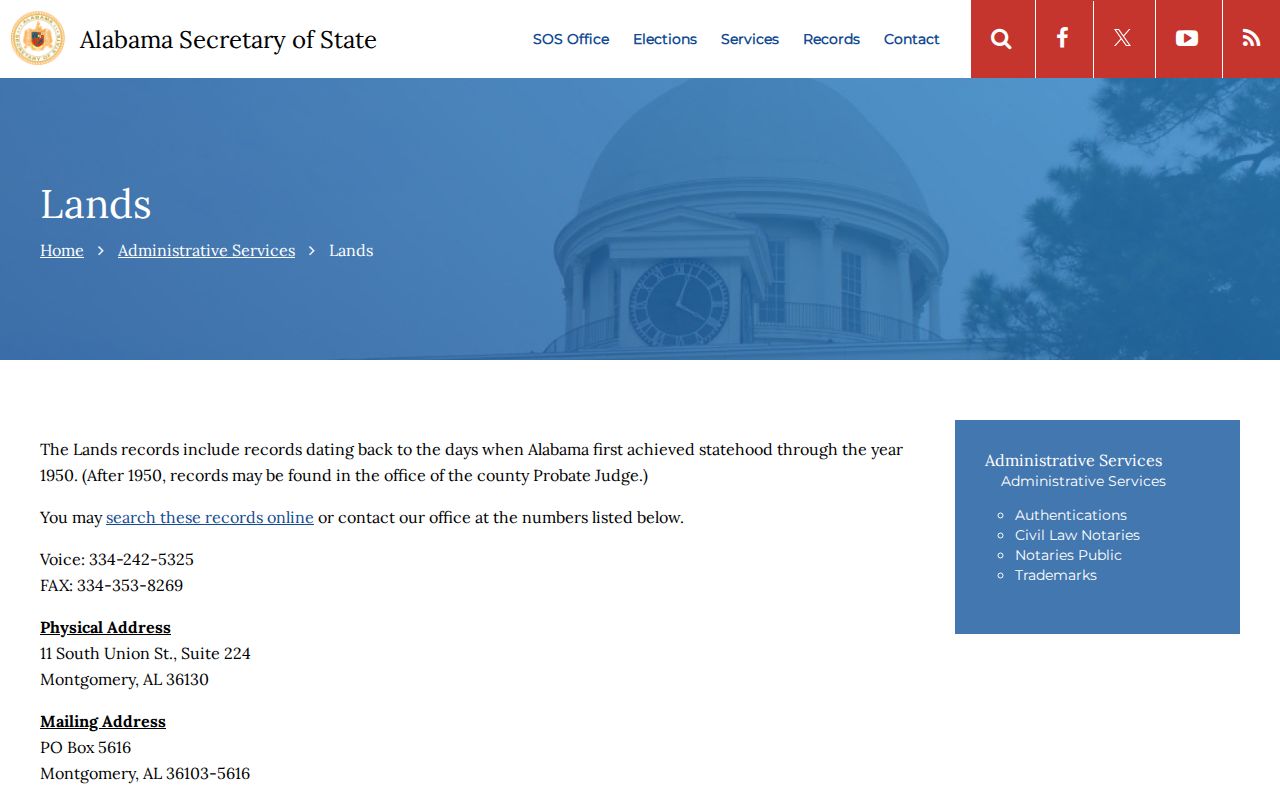
The page spells out where state-held land material ends and county-recorded instruments begin, which keeps a St. Clair property search aimed at the right custodian.
Obtain a St. Clair County Deed Copy
Begin with Probate, by phone or at either courthouse, since no public deed-image portal exists. Supply the parties, an approximate date, the legal description, and any recording reference. Ask which location holds the record, whether mail requests are accepted, what staff can search for you, and whether copies can be certified.
Recorded does not mean title cleared. A filed deed shows that instrument; it is not a title opinion and does not rule out other interests.
Track every name, spelling variant, date range, and reference number as you work through the deed records. A title professional can handle a legal or transaction decision that calls for a full examination rather than one public copy.