
Core Fields in St. Clair County Property Tax Records
The county owner-parcel layer and the tax system show different pieces of the property tax records. Read every number by its label. Appraised or total value is not assessed value, and a sale field captures transaction data rather than a current market opinion.
| Field | What It Shows | Where |
|---|---|---|
| Appraised or total value | County valuation before the class ratio | Revenue record and GIS |
| Assessed value | Tax base produced by the statutory class rate | Revenue record and GIS |
| Land and improvements | Components of the total valuation | Owner-parcel layer |
| Exemption | Relief shown for the parcel, subject to eligibility | Revenue record |
| Tax district and status | Applicable geography and current payment information | Tax portal |
Alabama reaches assessed value by multiplying appraised value by a class rate. Millage and exemptions then drive the tax due. A recent deed price can help explain a valuation, but it never substitutes for either county field.
Eight Ways to Search St. Clair County Tax Records
The Revenue Commissioner property search covers tax years 2019 through 2027, with 2026 selected as the default. Eight search types are available. PPIN becomes especially useful when an address is blank or formatted differently in the parcel data.
| Search choice | Best starting information |
|---|---|
| Name | Exact owner style or a cautious partial name |
| Address | Street number and street name |
| Parcel Number / PPIN | Stable parcel identifier copied from a prior result |
| BPPIN / Account | Identifier already present on county material |
| Subdivision | Recorded or assessment subdivision name |
| Receipt# | Known county payment reference |
The official page displays the year selector and its fields. It shows no live parcel result. Confirm current fields directly in the portal.
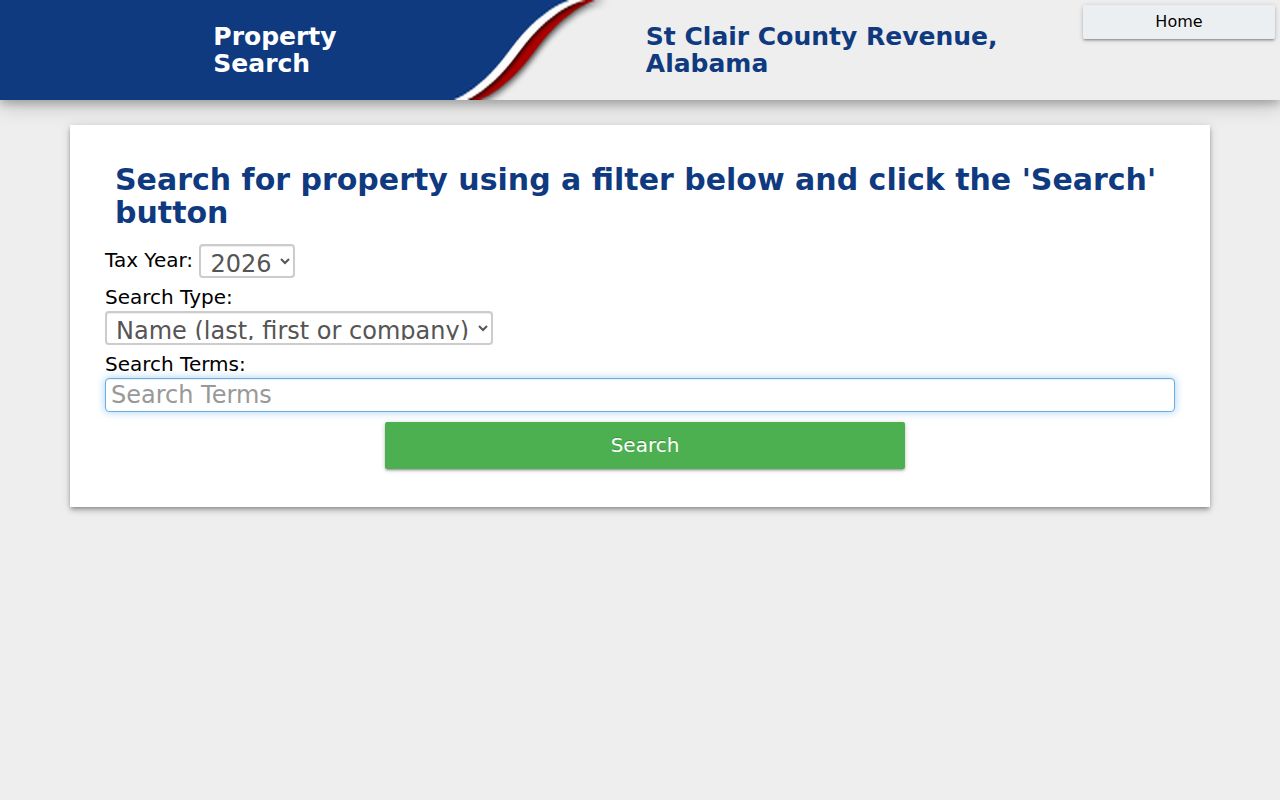
Carry the selected year with every result. A prior-year owner, exemption, or value can differ from the current roll.
Retrieve a St. Clair County Property Tax Bill
Search the official portal, then keep property identity separate from payment. Before reading the bill, confirm an address result with the PPIN, situs, tax year, and district.
- Select the correct tax year and search by address, name, parcel number, or PPIN.
- Open the matching parcel and verify its situs, owner style, PPIN, and tax district.
- Read value, classification, exemption, amount, and payment status as distinct fields.
- For delinquency, compare the live record with the county's current calendar and sale notice.
- Assessed value
- The appraised value after its statutory class rate is applied.
- Millage
- A rate applied to assessed value as part of the tax calculation.
- Homestead exemption
- Qualified primary-residence relief confirmed by Revenue.
- Tax lien
- A claim arising from unpaid tax, subject to the county's sale and redemption process.
St. Clair County's Property Tax Calendar
The official property-tax information page sets the county's calendar. Real-property taxes are due October 1 and become delinquent January 1. Delinquent real property runs in a tax-lien auction advertised for three straight weeks beginning in March. Notice goes out in April. The auction itself is held in May. A broad calendar cannot tell you the status or terms of one parcel, so let current notices control.
A bill that never arrives still leaves the obligation intact. Check the parcel directly and contact Revenue when a payment or ownership update is unclear.
Millage Geography Changes St. Clair County Property Tax
The county calculator mixes county, municipality, and school layers into combined districts. County-Ashville sits at 31 mills, and County-Pell City sits at 36. Moody-Moody runs 51, Pell City-Pell City runs 41, and Trussville-Trussville runs 43. Treat each label as a district pairing. Never apply a rate from a mailing-city name. The county calculator and millage page works a Class III example. $100,000 appraised value becomes $10,000 assessed value at the 10 percent rate. Then 26 mills yields $260 before exemptions. The official page displays that same county example.
Never calculate a live bill from an address alone. Confirm the parcel's classification, district fields, exemptions, and current millage first.
Homestead Entries in St. Clair County Tax Records
The county tax guide describes the regular homestead comparison as using a 10 percent rather than 20 percent assessment rate. Occupancy is required by persons named on the deed. A primary-residence exemption cannot be claimed elsewhere. Alabama DOR lays out H-1 through H-4 categories, each with its own requirements and limits. Age, disability, blindness, and income documentation can all matter under county and state guidance. A person age 65 must apply before December 31 for the next year. Bring an income-tax return and driver's license. Ask Revenue which exemption appears on the parcel. Also ask what form is current, and whether renewal applies. Never infer eligibility from an owner's age or a property's appearance.
Why a St. Clair Tax Bill May Show the Prior Owner
Deed recording, assessment transfer, exemption filing, and the next bill are separate events. The county guide tells a buyer to record with Probate, assess with Revenue, and claim an exemption. For property bought on or before October 1, finishing by December 31 puts the next year's bill in the new name.
Treat the owner field as a dated assessment clue. Title runs through the latest recorded deed. Ask Revenue about a pending assessment update rather than reading a stale billing name as proof of current ownership.
St. Clair County Tax-Lien Records and GovEase
The county sends auction traffic to GovEase, which hosts the public auction landing page and the bidder account route. The platform stands apart from the county's official property tax calendar and from any parcel-specific sale terms. A tax-lien auction is not an ordinary deed purchase. Consult the current St. Clair County notice, parcel status, bidding rules, and redemption information before relying on an auction listing. The county publishes no parcel-specific St. Clair sale list with complete terms on a generic platform page. No platform date should replace the county's own notice.
Challenge a St. Clair County Property Tax Assessment
Begin with the St. Clair Revenue Commissioner and request the current local appeal calendar, form, and filing instructions. The county publishes no Board of Equalization calendar or parcel appeal form, so never assume a local date. Preserve the notice and its mailing or delivery date.
Confirm the correct appeal window. Alabama DOR says a final-assessment appeal may be filed within 60 days of mailing or delivery, but the county's local review process must be obtained from Revenue.
Strong evidence starts with the assessor's current property record card. Set it beside the prior-year assessment so changes in class, exemptions, and value stand out. Photographs, permit history, flood or access data, and a legal description or survey round out the file when they apply to the parcel. Comparable recorded deed sales make the best market evidence, since they show what buyers actually paid. One caution applies. A permit reflects construction cost, not market value. A neighboring value on the GIS map is not automatically a true comparable for a St. Clair County property tax appeal.