
Trace St. Clair Previous Owners Backward
A backward deed timeline begins with a parcel you have positively identified. The county GIS carries previous-owner and last-deed fields. Those can supply leads, but the entries reflect assessment and mapping data rather than a complete chain of title. St. Clair County publishes no public grantor-grantee portal. The Judge of Probate remains the official recording route for deed records here.
| Transfer stage | Grantor to grantee | Deed evidence | Parcel check |
|---|---|---|---|
| Latest | Prior owner to current grantee | Newest deed reference | PPIN and legal description |
| Earlier | Earlier grantor to prior owner | Prior deed book | Same-property clause or acreage |
| Split or merge | Parent tract to child | Deed and recorded plat | Parent and child descriptions |
| Historic tract | Names in old index | Book, microfilm, catalog lead | Metes and bounds or neighbors |
Give every row a transfer date, a deed type, and a book, page, or instrument number. Names alone are weak evidence. A legal description with lot and block, acreage, a road or rail line, a creek, or an adjoining-owner call keeps the row pinned to the same land as the chain moves deeper into the county's property records.
Start with St. Clair Parcel Clues
The St. Clair owner-parcel layer exposes PPIN, Parcel ID, sale fields, last-deed data, previous owner, subdivision, neighborhood, acreage, child PPIN numbers, and geometry. Use those fields to pin down the land before you chase past owners. A blank address or subdivision does not end the work. The same layer documents the parent-child parcel relationships that often explain a thin sale history.
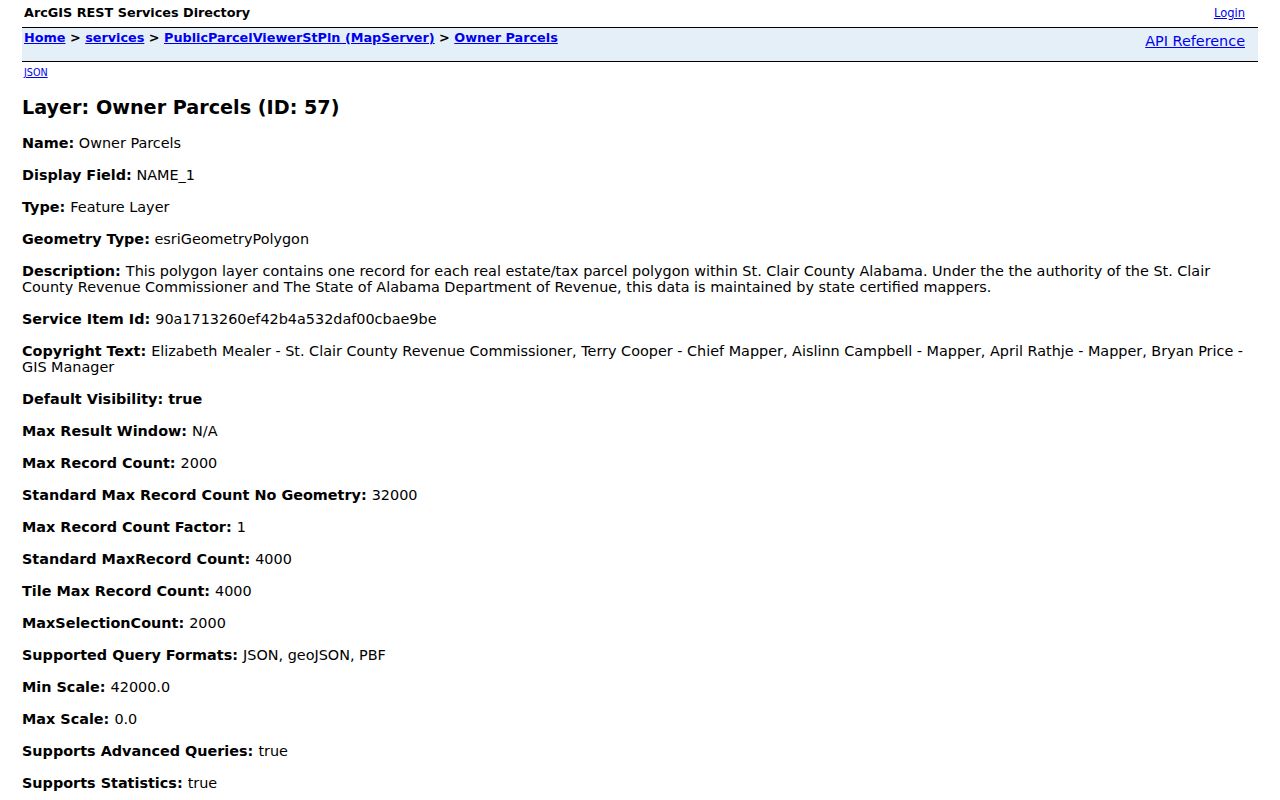
GIS is a starting point, not a title chain. Save the service date and the raw name style, then move to the recorded instrument in the deed records.
Reach St. Clair's Older Books
The county publishes no online deed index, so no cutoff year applies to remote research. St. Clair County Probate maintains counters in Ashville and Pell City. Ask which office can pull the book or index you need before you travel.
The FamilySearch catalog lists St. Clair land records covering 1823 to 1918 and an index lead spanning 1819 to 1903. WorldCat lists filmed probate records from 1850 to 1952. The Alabama Department of Archives and History offers catalog, county-record, and microfilm paths. It also covers newspapers and maps. Requests are another option. A catalog entry does not mean an image sits freely online.
Access limit. Continue older-owner work through Probate, deed books, microfilm, and archives because no public St. Clair deed portal was verified.
Reconstruct St. Clair's Deed Chain
Read the chain in reverse, starting from a deed that clearly matches your parcel. Legal descriptions outlast address changes by decades.
- Record the current deed's grantee, grantor, dates, type, reference, and land description.
- Search that grantor as an earlier grantee and confirm the same tract.
- Repeat, noting corrections, quitclaims, estate deeds, easements, and plat references.
- Move to reverse indexes, books, microfilm, and catalogs when modern access ends.
- Grantor
- The party conveying an interest.
- Grantee
- The party receiving it.
- Chain of title
- The linked transfers for the same land.
- Reverse index
- An index that finds a name in the opposite deed role.
- Quitclaim
- A deed conveying only the interest the grantor may hold.
Follow St. Clair Parcel Splits
A child PPIN can carry little sale history while its parent tract is old. Compare child-number fields, acreage, subdivision, block and lot, and geometry. Ask planning for subdivision files. Ask Probate for the final recorded plat, easements, road dedications, restrictions, and parent-to-child deeds. Approval, recording, parcel creation, assessment, and first sale can each carry a different date. The county's 2026 subdivision rules set an August 15, 2026 effective date. Apply that cutoff only to files governed by those rules.
Decode Historic St. Clair Places
Place names in old deeds make more sense with the county's timeline in hand. St. Clair County was formed in 1818. Ashville became the county seat in 1820. Pell City grew after railroad links arrived in 1887. Its courthouse dates to 1904, and courts returned there in 1907. Those facts explain the station, rail, courthouse-square, road, and community names that fill historic deed records.
History interprets the chain; it does not replace it. Compare old calls with maps and adjoining owners, then return to the deed book.
Handle St. Clair Estate Conveyances
A clean sale sequence can break at an estate. Land may also pass through a trust, correction, or court order. Find the Probate estate authority. Then find the final administrator or executor deed. A quiet-title docket is distinct from the recorded instrument that follows it. Treat the docket as context. The recorded deed remains the proof of ownership.
When a business appears in the chain, state entity and UCC files provide context only. An agent, officer, or permit applicant is not automatically a prior owner. The deed records must say so.
Resolve Same-Name St. Clair Owners
Two people can share a name in the St. Clair County indexes. The risk rises with initials, suffixes, married names, and entity abbreviations. Never connect deeds on a name alone. Compare spouse or co-owner style, deed dates, legal descriptions, acreage, subdivisions, and adjoining owners, plus the book reference a later deed carries forward. Search spelling variants freely. Record the exact index entry behind each candidate. The current PPIN rarely appears in the oldest deed, so build a bridge through later instruments that quote an earlier description or state the land is the same property.
A street address is the weakest historic join because roads and mailing labels change. When two candidates survive, label both. Ask Probate staff to check the direct and reverse indexes rather than choosing the neater story.
Route St. Clair Archive Requests
Pick the right channel before you write. Probate holds the recorded real-estate instruments for St. Clair County. ADAH supports county records, maps, newspapers, microfilm, and a St. Clair subject finding aid. FamilySearch and WorldCat list catalog entries and filmed-book routes. Local library and historical collections can surface alternate community, rail, mill, road, or courthouse names.
Keep each request narrow. Give the known grantor or grantee, rough years, any deed-book clue, a legal description fragment, and the modern parcel that led you there. Ask whether the material is indexed, viewable at a courthouse terminal, on microfilm, or available by mail. Ask about copy fees too. Alabama public-record procedure works best when you request specific existing records. The county policy charges 25 cents per page, with staff research at $25 per hour past the first hour, plus supply costs. A custodian may still use its own form and procedure.
Record St. Clair Chain Gaps
A gap does not prove nothing happened. The break might come from a spelling variant, an estate transfer, a correction deed, a parcel split, or a different index role. An older book you have not reached yet, or a court-directed conveyance, can hide the link just as easily. Track the last verified grantee, the legal description, the date, the book reference, your search variants, the repositories checked, and the first unresolved link.
Never bridge the gap with the GIS previous-owner field. It may reflect a single assessment update, nothing more. A zero sale price does not mean no conveyance either. Read the instrument type and consideration language in the deed, then run the prior grantee search again. That discipline keeps any St. Clair County former-owner chain honest and reproducible.
Label St. Clair Evidence Carefully
Precision in labels matters. Reserve "recorded instrument" for a deed, plat, mortgage, easement, release, or other Probate item. Identify each one before you label it. Treat GIS names and sale fields as county assessment or mapping clues, not title evidence. Archive catalogs and library history supply context. A court docket stays distinct from a later recorded title event. Labeled this way, another researcher can reproduce the chain. That person can test a weak link and still keep a useful local lead.
Measure St. Clair Ownership Depth
How deep you can go varies by parcel and by the index path that survives. State land material, county recording, FamilySearch, WorldCat, Probate, and ADAH are separate channels. None promises a digitized page. Mark the gaps, the same-name ambiguity, and any mismatched acreage rather than forcing a conclusion. Preserve the repository and the search date. Keep the spelling used and the book requested. Note the index role as well. The next researcher can then test the same former-owner trail. Record negative searches too, since they stop the same dead end from being repeated.
Lawful use. Former-owner research supports house history, estates, and purchase diligence. Never use it to track, harass, intimidate, or harm a living person.